A: If we have stock, MOQ 3000pcs. | B: If out of stock, MOQ is 10000pcs.


Views: 0 Author: Rui Publish Time: 2026-09-15 Origin: Site


The global glass dropper essential oil bottle market continues to expand as aromatherapy, natural cosmetics, and wellness products gain traction across North America, Europe, and Asia-Pacific. Market research indicates that 5 ML, 10 ML, 15 ML, and 20 ML capacities represent the primary product segments driving wholesale demand, with applications spanning perfume, massage oil, and cosmetic formulations. For distributors, brand owners, and procurement managers, selecting the right wholesale glass essential oil bottle supplier involves evaluating material specifications, closure compatibility, and manufacturing tolerances that directly affect filling line efficiency and product shelf life.
This guide provides a technical and commercial overview of wholesale glass essential oil bottle sourcing, drawing on industry standards and manufacturing data relevant to B2B procurement decisions.
The glass material used in essential oil bottles directly influences chemical inertness, light protection, and mechanical durability. According to the international standard for essential oil packaging, Type III glass (soda-lime glass) is recommended for both food-grade and pharmaceutical-grade essential oils, with the caveat that hydrolytic resistance must meet pharmacopeia requirements where applicable. The standard further specifies that colored, non-actinic glass should be used in all cases where light exposure is a concern.
For wholesale buyers, this means that the glass composition and color are not aesthetic choices alone—they are functional requirements tied to product stability. A wholesale glass essential oil bottle that fails to filter ultraviolet radiation will accelerate photodegradation of sensitive essential oil compounds, potentially reducing shelf life and altering aromatic profiles.
Amber glass remains the industry standard for light-sensitive essential oil packaging. The amber tint is produced by combining iron, sulfur, and carbon during glass melting, resulting in a reduced glass that absorbs most ultraviolet radiation, particularly wavelengths shorter than 450 nanometers.
A widely cited study conducted for the beer industry at Monmouth College compared light transmission through different glass colors and confirmed the following order of protection from high-energy light: amber glass provided the highest protection, followed by green glass, cobalt blue glass, and clear glass. This data supports the continued preference for amber wholesale glass essential oil bottles among brand owners who prioritize formulation integrity.
That said, cobalt blue and green glass options serve specific positioning needs. Blue glass offers moderate UV filtering while providing visual differentiation on retail shelves. Green glass performs better than blue or clear glass but remains less protective than amber. For wholesale buyers, the choice between amber, blue, green, or clear glass should balance protection requirements against brand differentiation and cost considerations.
A glass bottle's neck finish—not its body shape or capacity—determines which droppers, caps, and closures will fit. Most neck finishes follow the GPI (Glass Packaging Institute) or SPI numbering convention, expressed as two numbers separated by a hyphen, such as 18-400 or 20-400.
The first number indicates the outer diameter of the finish in millimeters. The second number is a thread style code, with 400, 410, 415, and 425 being the most common series. A critical distinction: 24-400 and 24-410 have the same diameter but different thread heights, meaning a cap designed for one may not seal properly on the other. This is one of the most frequent errors in wholesale glass essential oil bottle procurement—buyers assume that matching diameters guarantee compatibility.
For essential oil bottles, the most common finish families in wholesale orders are 18-400 and 20-400, covering small perfume, essential oil, and dropper bottles typically ranging from 5 ML to 50 ML. The DIN 18mm finish (also referenced as GL18 or JY18) is particularly prevalent for essential oil dropper bottles, with a typical inner diameter of 10.65mm, outer screw diameter of 17.75mm, and skirt diameter of 20mm.
Wholesale buyers should always request a physical sample of the bottle and closure together before committing to a production run. Even when finish codes match on paper, tolerances vary between manufacturers, and a cap that is slightly undersized may leak under pressure testing, while an oversized cap may fail to seal entirely.
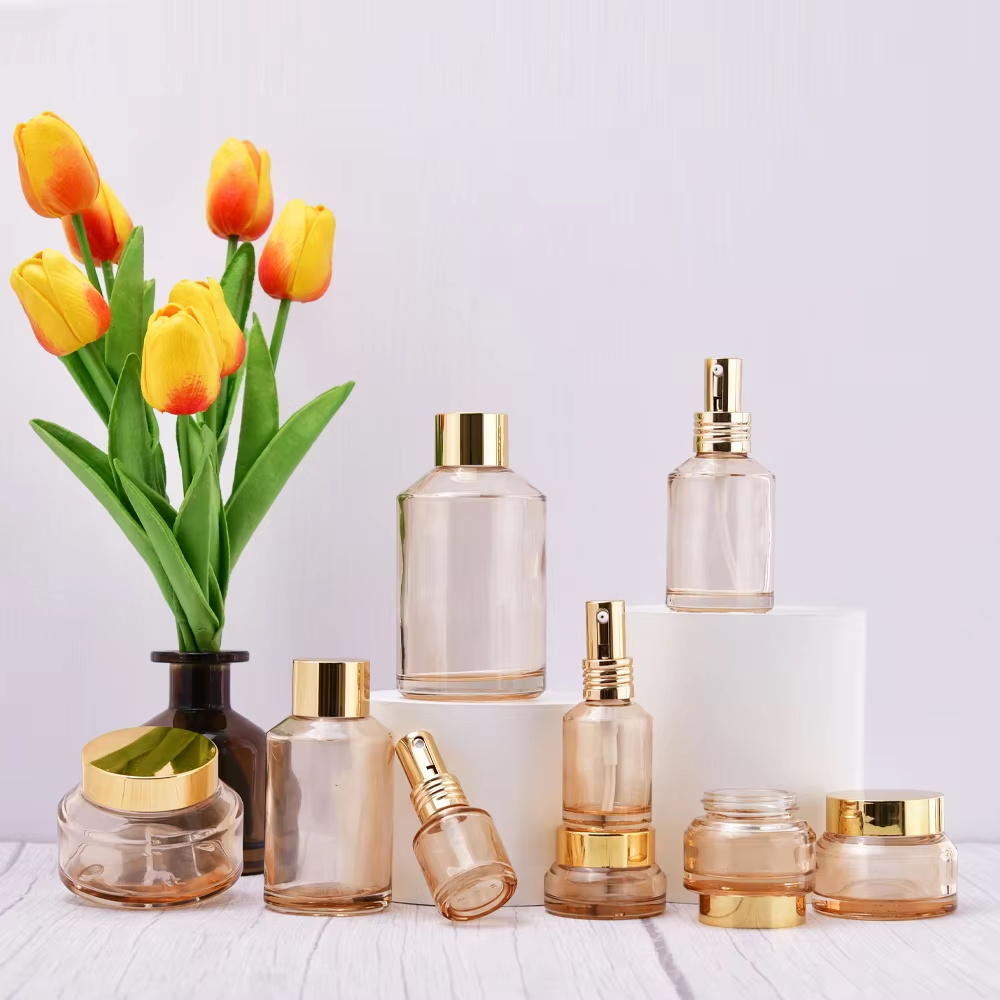
Essential oil bottles require dispensing systems that control flow rate, minimize air contact, and maintain seal integrity during transport. The most common closure types for wholesale glass essential oil bottles include:
Dropper assemblies consist of a collar, a rubber or silicone bulb, and a glass pipette. Dropper collars screw onto the neck finish, and pipette length is selected based on the bottle's internal height to ensure the tip reaches near the bottom without contacting the glass. For a 10 ML square bottle with 30mm width, a 35mm pipette positions the tip approximately 5mm from the bottle bottom.
Euro droppers (orifice reducers with screw caps) insert into the neck finish and restrict flow to a small opening, covered by a secondary screw cap. These are common for essential oil bottles intended for drop-by-drop dispensing without a separate pipette.
Roll-on balls are used for essential oil blends applied directly to skin. The ball sits in the neck finish, and a screw cap secures it when not in use.
Pump sprayers serve essential oil blends formulated for room spraying or misting applications.
Material compatibility for dropper bulbs is also a consideration. Common bulb materials include butyl rubber, natural rubber, silicone, and nitrile. Silicone and nitrile offer better chemical resistance to essential oil constituents than natural rubber, which may degrade over time with prolonged contact.
Body shape influences both shipping economics and branding capabilities. Square glass essential oil bottles offer measurable advantages in packing density. Because square bottles fit together without the interstitial gaps inherent to round bottles, a standard export carton measuring 400mm × 300mm × 200mm holds approximately 400 square 10 ML bottles, compared to 300 round bottles of the same capacity. This represents a 25% increase in carton density, translating to a corresponding reduction in shipping cost per bottle.
Print area is another differentiating factor. A round bottle presents a curved surface that limits printable area and requires curved screen plates. A square bottle has four flat sides, each suitable for flat screen printing. The flat surface allows higher print quality and more detailed artwork because the screen maintains consistent contact with the glass.
For wholesale buyers evaluating square versus round formats, the decision should account for total landed cost (including freight), branding requirements, and filling line compatibility. Square bottles may require adjustments to label application or capping equipment if the line was originally set up for round containers.
Reliable wholesale glass essential oil bottle suppliers implement standardized testing protocols to ensure batch-to-batch consistency. Three tests are particularly relevant for essential oil packaging:
Vertical load resistance measures the bottle's ability to withstand compression during capping and filling operations. A universal testing machine compresses the bottle between flat plates at a controlled rate until failure. For a 10 ML bottle, a minimum vertical load of 150 newtons is a typical specification for treated soda-lime glass, with average results around 170 newtons.
Internal pressure testing determines burst strength. The bottle is sealed and subjected to increasing water pressure until failure. For 10 ML bottles, a minimum burst pressure of 8 bar is a common requirement, with average results of 11 bar for soda-lime glass and 14 bar for borosilicate glass. This test is relevant for bottles that may experience elevated temperatures during storage or transport, where internal vapor pressure increases.
Thermal shock testing evaluates resistance to sudden temperature changes. Bottles are immersed in a hot water bath followed immediately by a cold water bath at a specified differential. Soda-lime glass bottles typically pass a 40°C differential test with a 98% success rate, while borosilicate glass performs better at a 50°C differential with a 99.5% pass rate. For square bottles, a slightly lower differential of 35°C may be specified due to stress concentration at the corners, with a 95% pass rate.
Wholesale buyers should request test data from suppliers and, where possible, conduct incoming inspection on representative samples from each production lot.
Beyond basic glass manufacturing, wholesale glass essential oil bottle suppliers offer surface treatments that affect both branding and filling line performance.
Screen printing applies ceramic inks fired onto the glass at approximately 600°C. Fired ceramic ink resists washing, scratching, and chemical attack from essential oils. Registration accuracy between colors is typically maintained within ±0.2mm for round bottles and can reach ±0.15mm on square bottles due to the flat printing surface. Minimum order quantities for printed bottles are often in the range of 20,000 pieces per design.
Cold end coating is applied after annealing to provide lubrication and improve label adhesion. The coating is typically a polyethylene emulsion sprayed onto the bottle as it exits the annealing lehr, with a thickness of less than one micrometer. The target coefficient of friction is typically 0.15 to 0.25, and label adhesion peel strength should reach approximately 2 newtons per 25mm width. Cold end coating is standard for bottles that will run on high-speed filling lines or receive pressure-sensitive labels.
Frosting creates a matte, hazy appearance through acid etching or sandblasting. Frosted bottles offer visual differentiation but may have slightly different surface friction characteristics than clear or amber glass, which can affect label application and handling.
Effective wholesale glass essential oil bottle sourcing extends beyond unit price. Several factors influence total cost of ownership:
Order quantity and volume discounts. Wholesale pricing for glass essential oil bottles follows tiered structures based on quantity. Standard deposit terms are 30% to 50% with balance due before shipment.
Finish standardization. Consolidating on a small set of neck finishes across a product catalog reduces closure SKU complexity, accelerates reorders, and minimizes the risk of mismatched components in inventory.
Documentation and compliance. For pharmaceutical or food-grade applications, suppliers should provide documentation of material safety, hydrolytic resistance, and compliance with relevant standards. This documentation is increasingly requested by regulatory bodies and retail partners.
Geographic sourcing considerations. China remains a significant production hub for glass packaging, with manufacturers serving export markets across North America, Europe, and Asia-Pacific. Guangzhou Ruijia Packaging Products Co., Ltd. is one such manufacturer, operating from Guangzhou, China, and supplying wholesale glass essential oil bottles to international customers. The company applies cold end coating as standard and offers screen printing with a minimum order quantity of 20,000 pieces per design.
The table below summarizes common specification considerations for different essential oil product categories:
Product Category | Recommended Glass Color | Typical Finish | Key Testing Priority |
|---|---|---|---|
Pure essential oils (undiluted) | Amber | 18-400 or DIN 18 | Light transmission, seal integrity |
Essential oil blends (diluted) | Amber or cobalt blue | 18-400 or 20-400 | Compatibility, closure function |
Massage oils | Amber or green | 20-400 or 24-400 | Vertical load, thermal shock |
Roll-on applications | Amber or clear | 18-400 with roller | Ball retention, leak resistance |
Room sprays | Cobalt blue or amber | 20-400 or 24-410 | Pump compatibility, burst strength |
This matrix is a starting framework. Actual specifications should be validated through sample testing with the intended formulation and filling process.
Selecting a wholesale glass essential oil bottle supplier requires balancing material science, manufacturing tolerances, and commercial terms. The decisions made at the specification stage—glass color, neck finish, body shape, closure system—ripple through filling efficiency, product stability, and brand perception.
For B2B buyers, the most reliable approach is to establish clear technical requirements, request test data and physical samples, and verify closure compatibility before committing to volume orders. As the essential oil and aromatherapy market continues to grow, the suppliers who invest in documented quality control and consistent tolerances will be best positioned to serve wholesale customers effectively.