A: If we have stock, MOQ 3000pcs. | B: If out of stock, MOQ is 10000pcs.


Views: 0 Author: Site Editor Publish Time: 2026-08-13 Origin: Site


The global glass cosmetic packaging market has experienced sustained growth, driven by consumer preference for premium materials and increasing demand for sustainable packaging solutions. The market is projected to reach USD 3.5 billion by 2031, with a compound annual growth rate of 5.5 percent. Glass containers are specified for skincare, fragrance, hair care, and treatment products where product protection and brand presentation are priorities. Guangzhou Ruijia Packaging Products Co., Ltd. operates as a wholesale glass cosmetic container supplier, serving clients across North America, Europe, and other international markets with capacities ranging from sample sizes to production volumes across multiple glass types and decoration options.
The glass cosmetic container market encompasses several product types including jars and containers, bottles, vials and ampoules. Skincare applications represent the largest end-user segment, followed by fragrance, hair care, and makeup categories.
Several factors contribute to sustained market growth. Consumer preference for premium packaging materials that communicate quality and purity has driven brands toward glass. The chemical stability of glass ensures that active ingredients remain effective over extended shelf lives. Sustainability requirements have further accelerated adoption, as glass is infinitely recyclable and can incorporate post-consumer recycled content. The rise of domestic cosmetics brands in emerging markets has also fueled glass packaging adoption, driving sustained growth in demand for mid-to-high-end glass containers.
China remains the dominant force in the global production of glass cosmetic containers, with manufacturing concentrated in industrial clusters that offer integrated supply chains, advanced infrastructure, and vertically integrated production capabilities. Guangzhou Ruijia Packaging Products Co., Ltd. operates within this ecosystem, leveraging regional advantages in manufacturing capability and export logistics.
Glass cosmetic container manufacturing in China is concentrated in several provinces, each offering distinct capabilities and service models. Understanding regional characteristics supports informed supplier selection.
Guangdong Province is home to vertically integrated manufacturers with advanced automation. The province benefits from established supply chains, logistics infrastructure, and access to international ports. Facilities in Guangdong often feature automated production lines, in-house R&D teams, and full-service support from design to logistics. Manufacturers in this region excel in innovation, customization, and export readiness. Guangzhou Ruijia Packaging Products Co., Ltd. operates from Guangdong, leveraging the region's infrastructure and packaging industry ecosystem.
Jiangsu and Shandong Provinces are known for glass formulation technology, producing containers with superior clarity, chemical resistance, and thermal stability. Jiangsu suppliers, particularly in Xuzhou, focus on precision molding and high-volume output. The proximity to Shanghai enables efficient export logistics.
Hebei Province is known for competitive pricing on standardized designs, ideal for bulk orders where cost efficiency is a priority without sacrificing baseline quality. Manufacturers in Hebei often accommodate larger order quantities and competitive pricing.
Anhui Province has emerged as a cost-effective alternative, with tier-2 cities offering lower operational expenses while maintaining ISO-certified production standards.
These regional ecosystems benefit from mature raw material supply chains, skilled labor pools, and government-backed industrial zones, making them attractive sourcing destinations for international buyers.
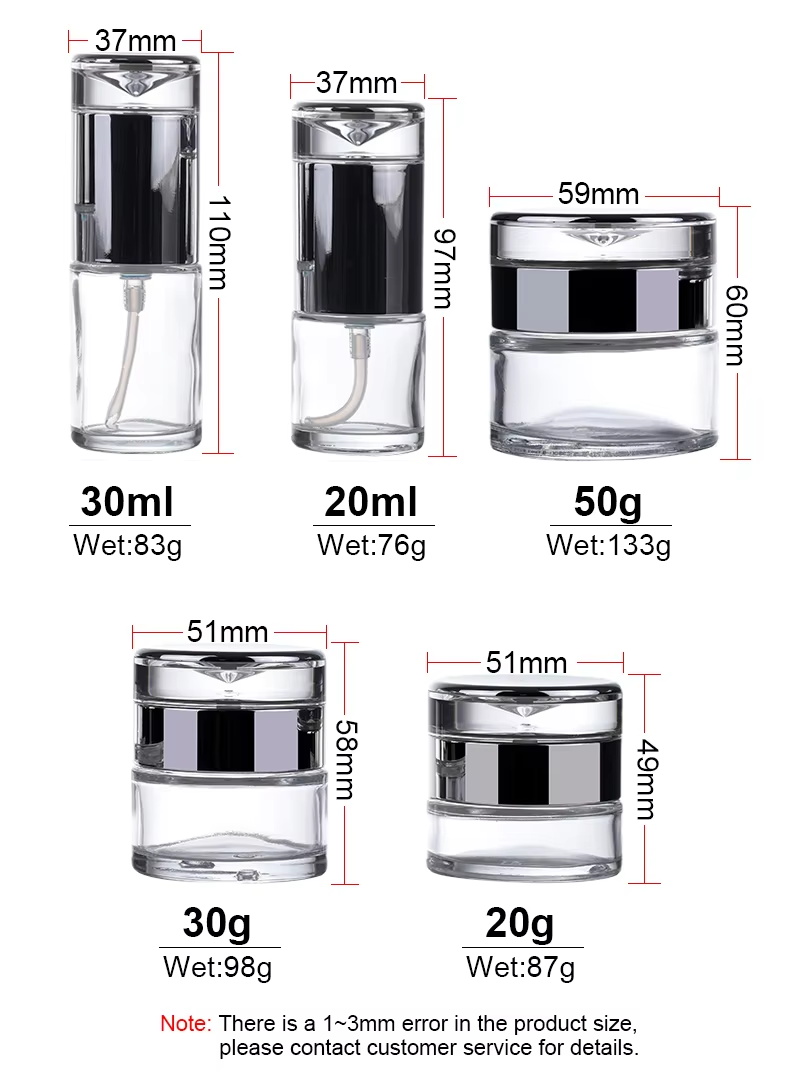
Glass cosmetic containers are manufactured from different glass compositions, each offering specific properties for various applications. Understanding material differences supports appropriate selection for specific product requirements.
Soda-lime glass is the most commonly used material for cosmetic containers. This glass type provides adequate chemical durability for most skincare formulations and is cost-effective for high-volume production. The material is suitable for standard creams, lotions, and moisturizers with typical storage requirements.
Borosilicate glass offers enhanced chemical resistance and thermal stability compared to soda-lime glass. This glass type is recommended for formulations requiring high heat resistance or chemical durability. Borosilicate glass provides better resistance to thermal shock and is more chemically durable.
Amber glass provides UV protection for light-sensitive formulations. The amber color is achieved through the addition of iron and sulfur compounds during glass melting. Amber glass blocks approximately 95 percent of UV radiation, helping preserve ingredients including vitamins, retinol, and botanical extracts. Cobalt blue glass provides similar UV protection with a different aesthetic. Clear glass offers product visibility but minimal UV protection, making it suitable for products with short expected shelf life or products stored in opaque secondary packaging.
Black glass has emerged as a strategic choice for brands seeking sophisticated presentation, providing both UV protection and a distinctive visual identity. Dark violet glass is also available for brands prioritizing bioactive or light-sensitive ingredients, with formulations that filter harmful UV rays while allowing beneficial light wavelengths to extend shelf life naturally.
Frosted glass finishes are achieved through acid etching or sandblasting, creating a matte surface texture. Frosted glass provides a soft visual appearance and improved grip. The finish can mask minor surface imperfections and fingerprints.
Guangzhou Ruijia Packaging Products Co., Ltd. manufactures cosmetic containers in soda-lime and borosilicate glass, with amber, clear, violet, black, and custom color options available. Surface finishes include glossy, matte, and frosted textures.
Glass cosmetic container manufacturing involves multiple technical processes that affect product quality, dimensional accuracy, and production efficiency. Understanding these processes supports evaluation of supplier capabilities.
Batch preparation involves weighing and mixing raw materials including silica sand, soda ash, limestone, and colorants. The batch composition determines glass properties including chemical durability, thermal shock resistance, and color. Colorant addition for amber, cobalt blue, or custom colors requires precise measurement to achieve consistent tint across production runs.
Melting occurs in furnaces operating at temperatures between 1,420 and 1,460 degrees Celsius. The melting process requires precise temperature control and residence time to achieve homogeneous glass composition. Advanced manufacturers have applied oxygen-enriched combustion systems to their main furnaces, raising the oxygen content in combustion air from conventional 21 percent to 28 to 30 percent, reducing natural gas consumption per unit compared with traditional combustion. Waste heat recovery units capture high-temperature flue gas to preheat incoming batch materials and combustion air via heat exchangers.
Forming processes for glass containers include pressing, blowing, and press-blow methods. The narrow neck press and blow process is commonly used for large batches of lightweight glass containers. Process parameters including glass temperature, mold temperature, and cycle time affect dimensional consistency and surface quality. Advanced manufacturers maintain tight dimensional accuracy across the cavity profile through precision mold engineering.
Annealing is a controlled cooling process that relieves internal stresses in formed glass. Annealing lehrs maintain specific temperature profiles to ensure complete stress relief. The annealing process involves multiple temperature stages, typically beginning at 620 to 680 degrees Celsius and gradually cooling through 500 to 535 degrees Celsius and 340 to 365 degrees Celsius before air cooling to room temperature. Polariscopic inspection confirms stress levels are within acceptable limits.
Quality control procedures include appearance inspection for surface defects including checks, blisters, cords, and contamination. Physical and volumetric checks confirm functional standards including dimensional accuracy, wall thickness, and closure compatibility. Heavy metal testing for lead, cadmium, arsenic, and antimony verifies compliance with regulatory limits.
Guangzhou Ruijia Packaging Products Co., Ltd. maintains process controls across melting, forming, annealing, and finishing operations. The company's in-house design group translates client briefs into functional 3D models, leveraging stereolithography 3D printing and CNC prototype machining to deliver physical models within five to seven working days, maintaining dimensional accuracy within 0.1 mm tolerance. This prototyping workflow typically reduces average project lead time compared with outsourced model-making.
Wholesale glass cosmetic containers are available in multiple capacity ranges and configurations to accommodate different product types and usage patterns.
Small-capacity containers from 5g to 30g are used for samples, serums, essential oils, and travel products. The 10g, 15g, and 30g sizes are common for facial creams, eye creams, and treatment products. These formats are suitable for premium facial skincare products where small quantities are appropriate for regular use.
Medium-capacity containers from 30g to 100g represent the most commonly specified sizes for daily-use skincare products. The 50g format is frequently specified for face creams, lotions, and moisturizers. The 100g format is used for larger skincare products and treatment formulations.
Larger-capacity containers from 150g to 500g are used for body care products, professional-use items, and bulk formats. The 250g and 500g sizes are frequently specified for body creams, body butters, and treatment products. The 4 oz (approximately 120ml) size is commonly used for body care and aromatherapy products.
Product types include screw top jars for creams, balms, and semi-solid products. Jars are available with wide mouths for easy product access. Closure systems include plastic screw caps, bamboo lids, metal closures, and custom closure options.
Guangzhou Ruijia Packaging Products Co., Ltd. supplies wholesale glass cosmetic containers across these capacity ranges and product types, with dimensional specifications available for client verification. The company manufactures containers for face cream, lotion, toner, perfume, serum, essential oil, essence, and other cosmetic products.
Glass cosmetic containers require compatible closure systems that provide sealing, product protection, and user convenience. Closure selection affects product integrity and consumer experience, with multiple options available for wholesale procurement.
Plastic screw caps are the most common closure type for glass cosmetic containers. Caps are available in multiple colors and finishes, including matte, glossy, and metallic finishes. Cap liners provide additional sealing performance, with options including induction liners, pressure-sensitive liners, and foam liners. Liner selection depends on product chemistry and sealing requirements. Cap color matching is available for brand coordination.
Bamboo lids have gained popularity as a sustainable closure option. Bamboo lids are manufactured from pressed bamboo fiber and provide a wood-like texture that complements natural and organic skincare positioning. Bamboo lids are available in light and dark finishes with custom branding through laser engraving. The combination of glass jar and bamboo lid is frequently specified for natural skincare product lines.
Metal closures including aluminum screw caps provide a premium appearance and robust sealing performance. Metal caps are available in brushed, polished, and anodized finishes. Induction sealing is commonly used with metal caps for extended shelf life. Metal closures offer good barrier properties and are compatible with automated filling lines.
Custom closures can be developed for specific project requirements, including proprietary closure designs, custom colors, and branded closure systems. Custom mold development for closures adds tooling investment and lead time. Minimum order quantities for custom closures typically exceed those for standard closures.
Closure compatibility with jar neck finishes must be verified. Neck finish dimensions including diameter, thread profile, and height affect closure fit and sealing performance. Manufacturers should conduct closure fit testing for each closure and jar combination.
Guangzhou Ruijia Packaging Products Co., Ltd. supplies glass cosmetic containers with closure matching and compatibility testing, offering plastic screw caps, bamboo lids, and metal closure options.
Decoration and customization services allow brands to differentiate their packaging and communicate product identity. Suppliers with comprehensive decoration capabilities offer a range of surface finishing options.
Silk screen printing provides durable ink application for logos and product information. The ink layer adheres to the glass surface, creating solids and patterns with noticeable texture. Silk screen printing is wear-resistant and durable, suitable for medium to high-volume production.
Hot stamping applies metallic foil to the glass surface using heat and pressure. This method creates metallic finishes in gold, silver, or custom colors. Hot stamping with micron-level registration produces bright and luxurious metallic textures, offering strong visual impact and a premium appearance.
Cold and hot color spraying are tuned separately for opaque coverage versus translucent tint effects, while gradient matte frosting is achieved through programmable acid-etching parameters that create a seamless fade from high gloss to deep satin.
Physical vapor deposition plating delivers metallic luster without generating hazardous effluent, offering environmental benefits compared to traditional plating methods.
Multi-material integration combines glass with acrylic, zamak alloys, ceramic, wood, or engineered polymer components into a single technical stream, addressing the increasing demand for material contrasts that reinforce brand identity.
Custom glass colors are available beyond standard amber and clear. Masterbatch colorants are added during glass melting to achieve specific tint requirements. Custom color matching is available for Pantone references or physical samples.
Guangzhou Ruijia Packaging Products Co., Ltd. provides decoration services including silk screen printing, hot stamping, frosting, spray coating, and multi-material integration. Custom color matching and design development are available for client-specific requirements. The company's tooling workshop operates advanced CNC machining centers that fabricate high-precision steel molds, maintaining dimensional accuracy within 0.02 mm across the cavity profile.
Sustainability has become an increasingly important factor in packaging selection, with glass containers benefiting from the material's inherent recyclability. Glass is infinitely recyclable without loss of quality, and post-consumer recycled glass content is available for incorporation into new containers.
Energy-efficient furnace technology has been implemented by leading manufacturers to reduce carbon footprint. Oxygen-enriched combustion systems reduce natural gas consumption per unit by approximately 15 to 18 percent compared with traditional combustion.
Waste heat recovery units capture high-temperature flue gas to preheat incoming batch materials and combustion air via heat exchangers, saving over 120,000 cubic meters of natural gas annually in typical operations.
Centralized baghouse dust collection systems maintain outlet particulate concentration stably below 20 mg/m³ for dust generated during batching, cutting, and cold processing.
Closed-loop cullet recycling systems collect production rejects, customer-returned bottles, and internal cold-processing scrap. Spectroscopic analyzers deliver chemical composition data of cullet piles rapidly, enabling real-time batch adjustment that keeps glass composition deviation within 0.15 percent even when cullet accounts for 40 to 50 percent of the batch. This practice cuts external raw material purchases substantially with no corresponding quality fluctuations.
Water-based eco-coatings with volatile organic compound content consistently below 50 g/L are qualified for interior and exterior applications, meeting REACH requirements.
These measures have decreased comprehensive carbon emission intensity per finished unit by approximately 22 percent over recent years in advanced manufacturing operations.
Selecting a wholesale glass cosmetic container supplier requires a structured approach that balances capability, reliability, and long-term partnership potential. A comprehensive evaluation should include several key dimensions.
Production capacity and operational stability are important indicators. Key indicators include factory size, workforce numbers, and years in business. Suppliers with larger facilities, sufficient staffing, and extended operating history typically demonstrate stable operations. Monthly output among verified producers often exceeds substantial quantities, with standard lead times ranging between 15 and 25 days.
Quality assurance and compliance verification are essential. Suppliers should provide documentation confirming ISO 9001 certification, FDA compliance, REACH compliance, and other applicable standards. Verification of certification authenticity through official databases or third-party audit reports is recommended. For cosmetic-grade glass, adherence to relevant specifications is non-negotiable, guaranteeing resistance to leaching and degradation when exposed to oils, pigments, and preservatives.
Operational responsiveness is a strong indicator of supplier maturity. Manufacturers responding to inquiries within four hours generally exhibit better project coordination and customer service discipline. On-time delivery rates above 95 percent indicate stable production planning. Reorder rates above 30 percent indicate high client satisfaction and repeat business.
Customization flexibility should match project requirements. Suppliers with in-house design, prototyping, and decoration services offer more control over timing and quality than those subcontracting these services. In-house design teams can significantly reduce development timelines.
Pricing transparency and cost structure should be understood before order placement. Quotations should include material costs, production costs, decoration costs, and shipping costs. Unit cost varies widely based on material, volume, and customization level. Stock designs typically have lower MOQs, while custom shapes require higher minimums.
Risk mitigation measures include milestone-based payments tied to production stages, third-party audits, and sample verification before full production orders. Physical samples should be requested and evaluated before committing to large orders.
Guangzhou Ruijia Packaging Products Co., Ltd. supports supplier evaluation through documentation, sample availability, and technical consultation. With over 13 years of customization experience, the company provides tailored solutions for brands looking to elevate product presentation while maintaining functionality. Sample availability and lead time quotes are provided upon request for brand verification and production planning.
Wholesale glass cosmetic containers from Chinese suppliers offer production capacity, material options, and customization capabilities for brands seeking premium packaging. The global glass cosmetic packaging market continues to grow, driven by consumer preference for sustainable packaging and premium presentation. China's glass packaging industry is concentrated in manufacturing hubs that offer integrated supply chains, advanced infrastructure, and specialized capabilities.
Glass provides chemical inertness, barrier protection, and infinite recyclability that support product integrity and sustainability goals. Material options including amber, clear, cobalt blue, black, and violet glass offer different protection properties for various formulations. Closure systems including plastic screw caps, bamboo lids, and metal closures affect sealing and user experience.
Quality control systems including ISO certification and compliance with FDA and REACH standards indicate systematic quality management. Production lead times for standard products range from 15 to 25 days, with longer lead times for custom projects. Sustainability initiatives including energy-efficient furnace technology and closed-loop cullet recycling support environmental responsibility.
Supplier evaluation should consider production capability, quality systems, customization services, lead time reliability, and communication responsiveness. A systematic evaluation framework supports informed supplier selection aligned with specific project requirements.
Guangzhou Ruijia Packaging Products Co., Ltd. manufactures wholesale glass cosmetic containers with capacities, glass types, and closure options suitable for skincare, fragrance, and personal care applications. Technical consultation, quality assurance, and logistics coordination support projects from specification through delivery. Sample availability and lead time quotes are provided upon request for brand verification and production planning.