A: If we have stock, MOQ 3000pcs. | B: If out of stock, MOQ is 10000pcs.


Views: 0 Author: Site Editor Publish Time: 2026-10-30 Origin: Site


An eye cream carries the highest value per gram and the smallest dose in the entire skincare routine, which makes its jar the least forgiving package a brand will specify. This article examines the 5 g to 30 g glass jar as an engineering problem, covering surface-to-volume ratio, seal integrity on a narrow neck, fill accuracy and the decoration constraints of a very small canvas.
Eye creams occupy an unusual position in the market. They are sold in quantities that would be trivial for a body lotion, often between five and thirty grams, yet they command some of the highest prices per millilitre in the category. The formula inside is usually the most expensive the brand makes, built around peptides, retinoids, caffeine or low-molecular hyaluronic acid, and it is applied to skin that is thin, delicate and unforgiving of irritation.
Those facts have packaging consequences. A small jar has a high surface-area-to-volume ratio, so the same headspace that would be harmless in a 200 ml cream represents a much larger proportion of the contents. The product is exposed to more air per gram, more light per gram and more handling per gram. Meanwhile the absolute cost of the glass is low, which means the economics of specifying a better jar are unusually favourable. An eye cream is one of the few categories where a genuinely superior container costs almost nothing in percentage terms.
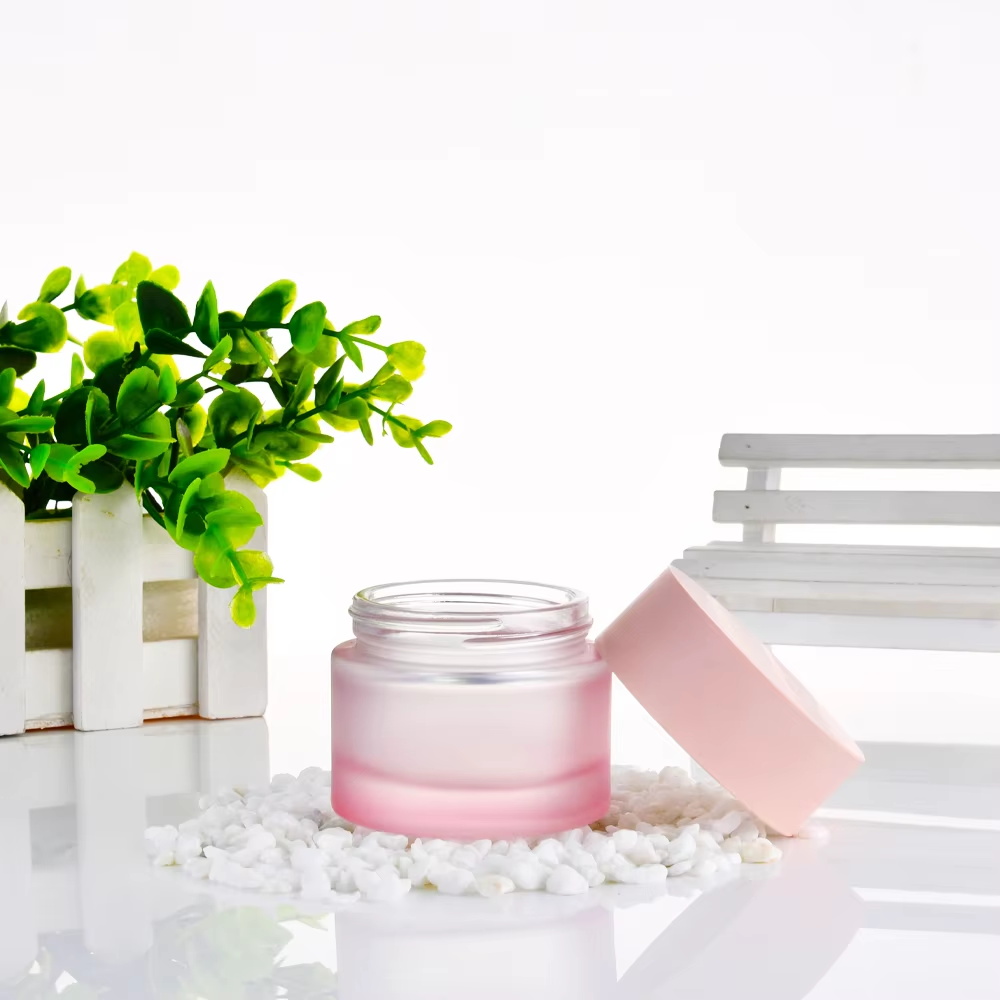
The jar is the traditional eye cream format and remains the most effective way to display texture. It allows the customer to see the surface, smell the product and judge its richness before purchase, and it accommodates thick balms that no pump could move. Its weakness is repeated exposure: every opening admits air and every finger contact introduces contamination.
An airless pump resolves the contamination question but hides the product and adds a component that must be qualified for compatibility and dose accuracy. A tube is economical and hygienic but reads as mass-market in a category where perceived luxury matters. A jar with an integrated spatula occupies a middle position: it preserves the visual and tactile appeal of a jar while reducing direct finger contact, and the spatula itself becomes a small branding opportunity.
Within the jar category, the squat format dominates for eye creams. A wide base relative to height gives stability on a narrow bathroom shelf and provides a generous surface for the product, while the low profile signals a small, precious quantity rather than an economy size. Double-wall construction is common at the premium end, since an outer shell can carry a heavy decorative finish while the inner wall remains a simple, compatible container.
It is intuitive to assume that a smaller jar is easier to close. The opposite is true. The seal depends on a gasket compressed between the lid and the neck rim, and the force that produces that compression is distributed around a smaller circumference. On a 30 mm neck, a small angular misalignment produces a larger proportional gap than the same misalignment on a 70 mm neck. The result is a jar that appears closed, passes a casual inspection, and yet allows gradual moisture loss.
The geometry of the neck rim matters as much as its diameter. A rim that is not flat, or that has a slight wave from moulding, will compress the gasket unevenly. Because the total force available is limited by the lid's torque, there is less reserve to compensate. This is why small jars benefit from a lug finish with a positive stop: the closure reaches a defined compression rather than relying on the customer's wrist.
Induction seals and integrated liners add a second barrier, and for a formula containing volatile actives or a high water content they are often justified. The seal must be qualified with the filled jar, not with an empty one, because the product's vapour pressure is part of the system.
A 10 g jar filled to 90 per cent leaves roughly one gram of headspace by volume. That is a small absolute amount, but it is ten per cent of the product, and it sits in contact with the entire exposed surface. If the headspace is air, the oxygen within it is available for oxidation from the moment of filling. Nitrogen flushing at the filling line reduces that reservoir, and a well-fitting liner prevents exchange afterwards.
Light follows the same logic. Amber or opal glass reduces transmission, but in a small jar the ratio of illuminated surface to protected volume is high, so the benefit is proportionally smaller than in a large container. A carton becomes more important, not less, for a premium eye cream, because the jar alone cannot compensate for its own geometry.
The formula's water activity adds a further consideration. Water can migrate through some gasket materials and through the interface between liner and neck, and a cream that loses two per cent of its water over a year may change viscosity and appearance. Weight-loss testing at elevated temperature is a simple and revealing check that many brands skip.
Fill tolerance is expressed as a percentage, which means it becomes tighter in absolute terms as the fill weight falls. A two per cent tolerance on a 200 g jar is four grams; on a 10 g jar it is 0.2 grams. Filling equipment must be capable of that precision, and the check must be gravimetric rather than volumetric, because eye creams vary in density depending on aeration.
Aeration is the hidden variable. A cream that has been whipped or that contains a high proportion of silicone may hold entrained air, and a volumetric filler will then overfill by volume while underfilling by weight. De-aerating the bulk before filling, and allowing the filled jar to settle before the lid is applied, produces a more consistent surface and a more honest label claim.
Product loss also matters more at this scale. A filling line that leaves half a gram on the nozzle wastes five per cent of a 10 g jar. Over a production run, that is not a rounding error; it is a material cost that should be visible in the quotation.
The lid of an eye cream jar may offer a printable diameter of forty millimetres and the body perhaps thirty. Within that area the brand must place a logo, a product name and often a legal statement. The constraint is not merely space but resolution: a screen print with a fine line will hold on a flat lid and blur on a curved shoulder, and a hot stamp that looks crisp in a large format can fill in at small sizes.
The practical response is to simplify. A single mark, generously scaled, reads better at this size than a detailed lock-up. Frosting or a soft-touch coating on the body reduces fingerprints, which matters because a small jar is handled more per gram than any other package. A metallic lid provides contrast without requiring print area. Where text is essential, it usually belongs on the carton rather than the jar.
Colour approval deserves particular care on small parts. A coating that looks correct on a 50 ml jar may appear darker on a 10 ml lid because the curvature concentrates reflection. Approve the smallest component first, then match the larger ones to it, rather than the reverse.
Glass cost scales with weight, and a small jar uses little of it. Decoration, by contrast, does not scale down: setting up a screen or a hot-stamp die costs the same whether the part is large or small, and the labour per unit is similar. As a result, decoration dominates the unit cost of a small jar far more than the glass does, and a brand that wants a premium appearance should invest in the finish rather than in additional wall thickness.
Freight behaves differently again. Small jars pack densely, which is favourable, but their low value per carton means the fixed cost of shipping is spread over fewer dollars of product. Consolidated shipments and efficient carton design therefore matter more than they would for a bulk order of large jars.
Guangzhou Ruijia Packaging Products Co., Ltd. produces glass cream jars in the 30 g, 50 ml, 100 ml and 120 ml range and a complementary plastic jar range from 5 g upward, which allows an eye cream to be developed in glass for the prestige tier and in plastic for travel or sample sizes without changing supplier. More than fifteen years of packaging experience, twelve bottle production lines, fourteen integrated systems and a workshop certified to 100,000-level purification underpin that range, with ISO, CE, SDS, SGS and FDA documentation available for export.
OEM and ODM services cover mould customisation and process customisation, including frosting, painting, electroplating, silk screen, laser carving and labelling, and the design team supplies free customised samples. For an eye cream, that last point is more valuable than it sounds: a five-gram jar cannot be judged from a rendering, and the only reliable test is to hold the decorated sample, fill it, and see how it behaves after a month on a shelf.
Q1. What size jar is standard for an eye cream?
Most eye creams are sold between 10 g and 20 g, with 15 g the most common compromise between perceived value and a realistic three-month course of use. Five-gram jars are usually samples or travel sizes, while 30 g is at the upper end and often reads as a face cream.
Q2. Is a jar or an airless pump better for retinol eye creams?
Airless pumps offer better protection for oxidation-sensitive actives because the product never contacts air. Jars remain viable where the formula is stabilised and the brand values texture visibility, but a well-sealed jar with a nitrogen-flushed headspace and an opaque carton is a reasonable alternative.
Q3. Why does a small jar lose moisture faster than a large one?
The surface-area-to-volume ratio is higher, so the same absolute loss represents a larger share of the contents. The seal also has a smaller circumference over which to distribute compression, which makes alignment more critical.
Q4. Can a 10 g jar be filled accurately on standard equipment?
It can, but the tolerance must be specified in absolute terms rather than as a percentage, and the filler must be capable of that precision. Gravimetric check-weighing and de-aeration of the bulk are usually necessary.
Q5. What decoration works best on a small lid?
A single, generously scaled mark in one colour or a metallic foil, applied to a flat or gently domed surface. Detailed lock-ups and fine text tend to fill in or blur at small diameters.
Q6. Should the jar and carton be sourced together?
For an eye cream, yes. The carton is the primary light barrier for a small jar, so the two components should be qualified as a pair rather than purchased separately and assumed to work together.